> ## Documentation Index
> Fetch the complete documentation index at: https://private-7c7dfe99-detect-table-modification.mintlify.site/llms.txt
> Use this file to discover all available pages before exploring further.

> Looker is an enterprise platform for BI, data applications, and embedded analytics that helps you explore and share insights in real time.

# Looker

export const PartnerBadge = () => {
  return <div className="PartnerBadge">
            <div className="PartnerBadgeIcon">
                <svg width="16" height="16" viewBox="0 0 16 16" fill="none" xmlns="http://www.w3.org/2000/svg">
                    <polyline points="12.5 9.5 10 12 6 11 2.5 8.5" stroke="currentColor" strokeLinecap="round" strokeLinejoin="round" strokeWidth="1" />
                    <polyline points="4.54 4.41 8 3.5 11.46 4.41" stroke="currentColor" strokeLinecap="round" strokeLinejoin="round" strokeWidth="1" />
                    <path d="M2.15,3.78 L0.55,6.95 A0.5,0.5 0,0,0 0.77,7.62 L2.5,8.5 L4.54,4.41 L2.82,3.55 A0.5,0.5 0,0,0 2.15,3.78 Z" stroke="currentColor" strokeLinecap="round" strokeLinejoin="round" strokeWidth="1" />
                    <path d="M13.5,8.5 L15.23,7.62 A0.5,0.5 0,0,0 15.45,6.95 L13.85,3.78 A0.5,0.5 0,0,0 13.18,3.55 L11.46,4.41 Z" stroke="currentColor" strokeLinecap="round" strokeLinejoin="round" strokeWidth="1" />
                    <path d="M11.5,4.5 L9,4.5 L6.15,7.27 A0.5,0.5 0,0,0 6.24,8.05 C7.33,8.74 8.81,8.72 10,7.5 L12.5,9.5 L13.5,8.5" stroke="currentColor" strokeLinecap="round" strokeLinejoin="round" strokeWidth="1" />
                    <polyline points="7.75 13.5 5.15 12.85 3.5 11.67" stroke="currentColor" strokeLinecap="round" strokeLinejoin="round" strokeWidth="1" />
                </svg>
            </div>
            Partner Integration
        </div>;
};

export const Image = ({img, alt, size = "lg"}) => {
  const normalizedSize = ["sm", "md", "lg"].includes(size) ? size : "lg";
  return <div className={`ch-image-${normalizedSize}`}>
      <Frame>
        <img src={img} alt={alt} />
      </Frame>
    </div>;
};

Looker can connect to ClickHouse Cloud or on-premise deployment via the official ClickHouse data source.

<Steps>
  <Step title="Gather your connection details" id="1-gather-your-connection-details">
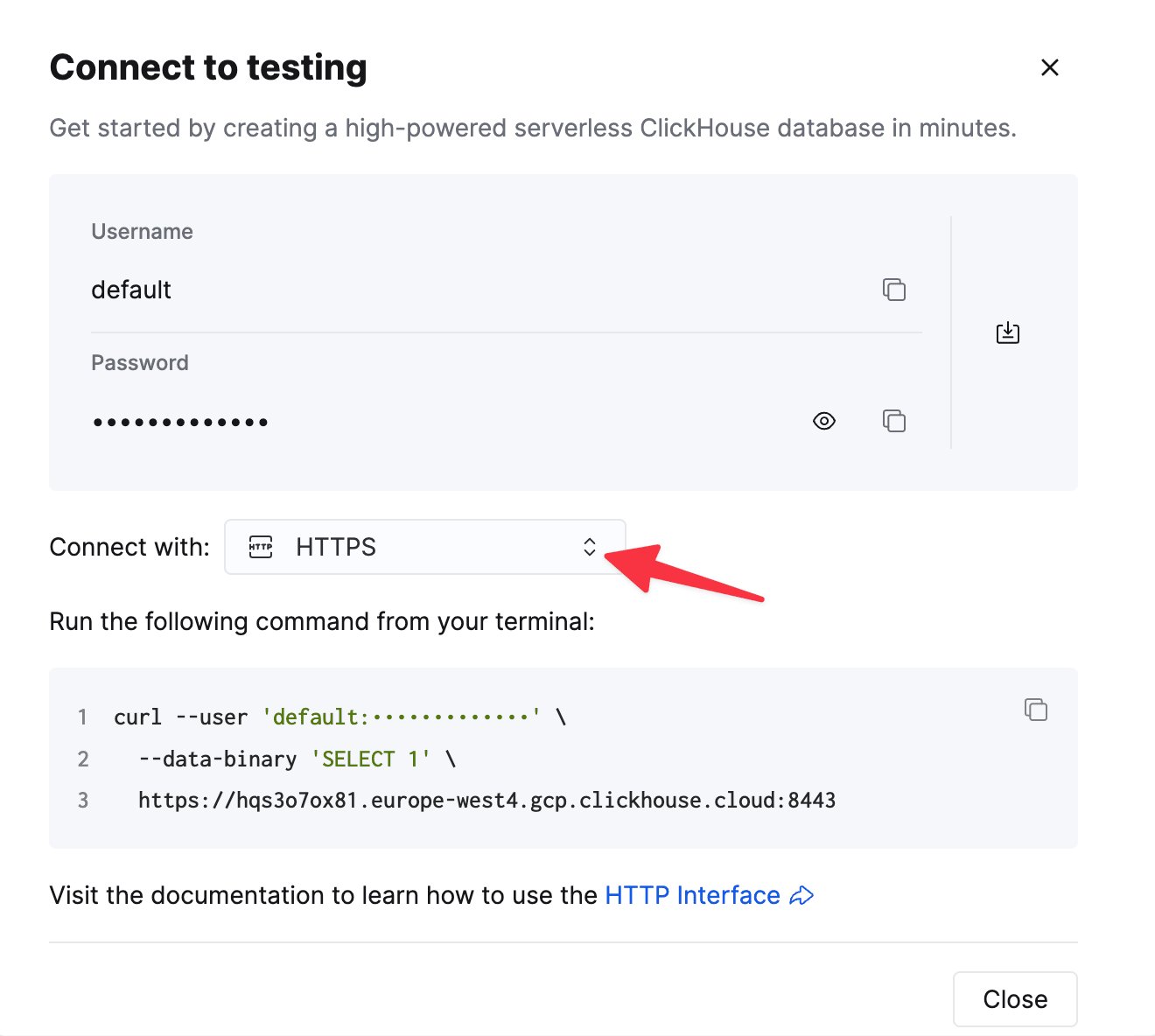
    To connect to ClickHouse with HTTP(S) you need this information:

    | Parameter(s)              | Description                                                                                                    |
    | ------------------------- | -------------------------------------------------------------------------------------------------------------- |
    | `HOST` and `PORT`         | Typically, the port is 8443 when using TLS or 8123 when not using TLS.                                         |
    | `DATABASE NAME`           | Out of the box, there is a database named `default`, use the name of the database that you want to connect to. |
    | `USERNAME` and `PASSWORD` | Out of the box, the username is `default`. Use the username appropriate for your use case.                     |

    The details for your ClickHouse Cloud service are available in the ClickHouse Cloud console.
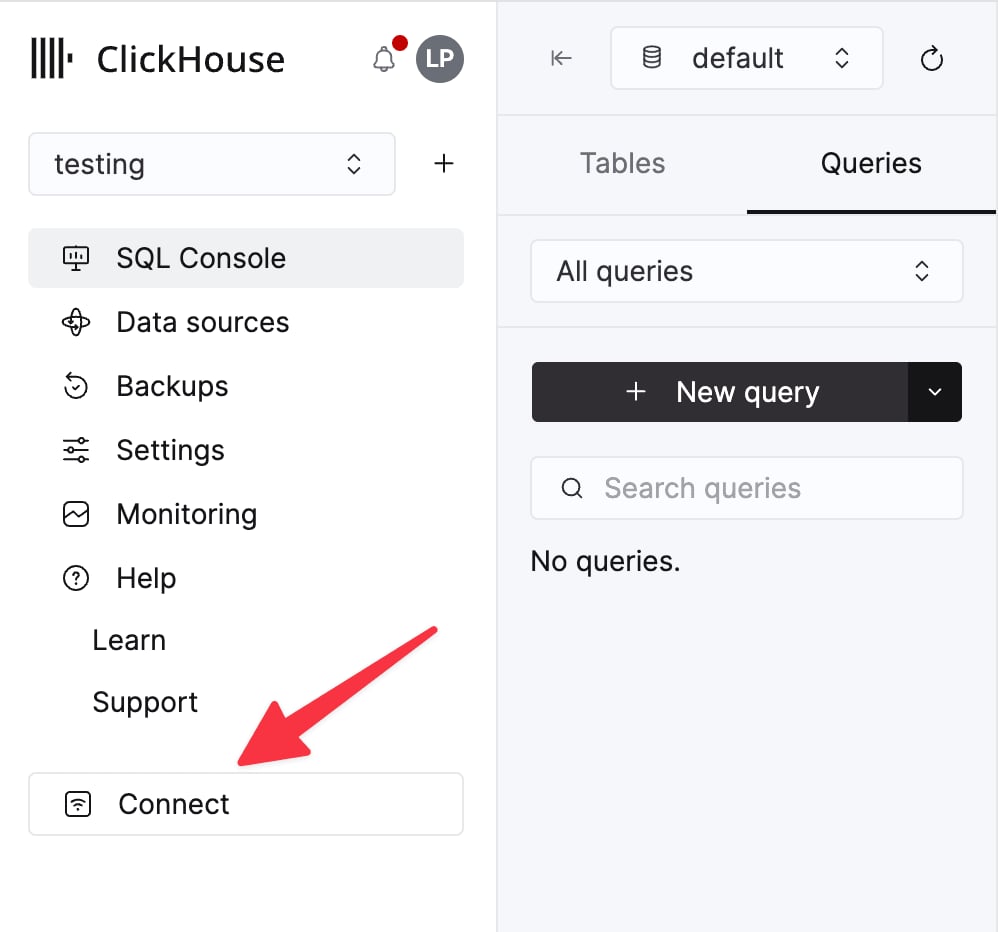
    Select a service and click **Connect**:

    <div className="ch-image-md">
      <Frame>
        <img src="https://mintcdn.com/private-7c7dfe99-detect-table-modification/0yJtAU6cqYAQlCWC/images/_snippets/cloud-connect-button.webp?fit=max&auto=format&n=0yJtAU6cqYAQlCWC&q=85&s=2d1e2340e1ddccf3199ca1e41eeba836" alt="ClickHouse Cloud service connect button" width="998" height="932" data-path="images/_snippets/cloud-connect-button.webp" />
      </Frame>
    </div>

    Choose **HTTPS**. Connection details are displayed in an example `curl` command.

    <div className="ch-image-md">
      <Frame>
        <img src="https://mintcdn.com/private-7c7dfe99-detect-table-modification/0yJtAU6cqYAQlCWC/images/_snippets/connection-details-https.webp?fit=max&auto=format&n=0yJtAU6cqYAQlCWC&q=85&s=2ea2af378046d5ec87ea8e78de573bc1" alt="ClickHouse Cloud HTTPS connection details" width="1320" height="1184" data-path="images/_snippets/connection-details-https.webp" />
      </Frame>
    </div>

    If you're using self-managed ClickHouse, the connection details are set by your ClickHouse administrator.
  </Step>

  <Step title="Create a ClickHouse data source" id="2-create-a-clickhouse-data-source">
    Navigate to Admin -> Database -> Connections and click the "Add Connection" button in the top right corner.

    <Image size="md" img="https://mintcdn.com/private-7c7dfe99-detect-table-modification/L7_COrR7NltKl_Va/images/integrations/data-visualization/looker_01.webp?fit=max&auto=format&n=L7_COrR7NltKl_Va&q=85&s=cb5846b6a77fb20c68023fab8a0e79b8" alt="Adding a new connection in Looker's database management interface" border width="1401" height="963" data-path="images/integrations/data-visualization/looker_01.webp" />

    <br />

    Choose a name for your data source, and select `ClickHouse` from the dialect drop-down. Enter your credentials in the form.

    <Image size="md" img="https://mintcdn.com/private-7c7dfe99-detect-table-modification/L7_COrR7NltKl_Va/images/integrations/data-visualization/looker_02.webp?fit=max&auto=format&n=L7_COrR7NltKl_Va&q=85&s=f708c905c47561747b4eb7ecaba82696" alt="Specifying your ClickHouse credentials in Looker connection form" border width="1454" height="1115" data-path="images/integrations/data-visualization/looker_02.webp" />

    <br />

    If you're using ClickHouse Cloud or your deployment requires SSL, make sure you have SSL turned on in the additional settings.

    <Image size="md" img="https://mintcdn.com/private-7c7dfe99-detect-table-modification/L7_COrR7NltKl_Va/images/integrations/data-visualization/looker_03.webp?fit=max&auto=format&n=L7_COrR7NltKl_Va&q=85&s=79bb19b7f3e09c738dbd5fee0384bae0" alt="Enabling SSL for ClickHouse connection in Looker settings" border width="1443" height="1116" data-path="images/integrations/data-visualization/looker_03.webp" />

    <br />

    Test your connection first, and, once it is done, connect to your new ClickHouse data source.

    <Image size="md" img="https://mintcdn.com/private-7c7dfe99-detect-table-modification/L7_COrR7NltKl_Va/images/integrations/data-visualization/looker_04.webp?fit=max&auto=format&n=L7_COrR7NltKl_Va&q=85&s=14abf082cdd131287b20e914e4ebc77c" alt="Testing and connecting to the ClickHouse data source" border width="1728" height="1210" data-path="images/integrations/data-visualization/looker_04.webp" />

    <br />

    Now you should be able to attach ClickHouse Datasource to your Looker project.
  </Step>
</Steps>

<h2 id="3-known-limitations">
  Known limitations
</h2>

1. The following data types are handled as strings by default:
   * Array - serialization doesn't work as expected due to the JDBC driver limitations
   * Decimal\* - can be changed to number in the model
   * LowCardinality(...) - can be changed to a proper type in the model
   * Enum8, Enum16
   * UUID
   * Tuple
   * Map
   * JSON
   * Nested
   * FixedString
   * Geo types
     * MultiPolygon
     * Polygon
     * Point
     * Ring
2. [Symmetric aggregate feature](https://cloud.google.com/looker/docs/reference/param-explore-symmetric-aggregates) isn't supported
3. [Full outer join](https://cloud.google.com/looker/docs/reference/param-explore-join-type#full_outer) isn't yet implemented in the driver